Transoral robotic surgery (TORS)
TORS removes tumors of the tonsil, base of tongue, and throat through the mouth. A surgical robot provides a magnified 3D view and instruments that turn in ways a human wrist cannot, so the tumor can be removed completely with no incision on the neck and no splitting of the jaw.
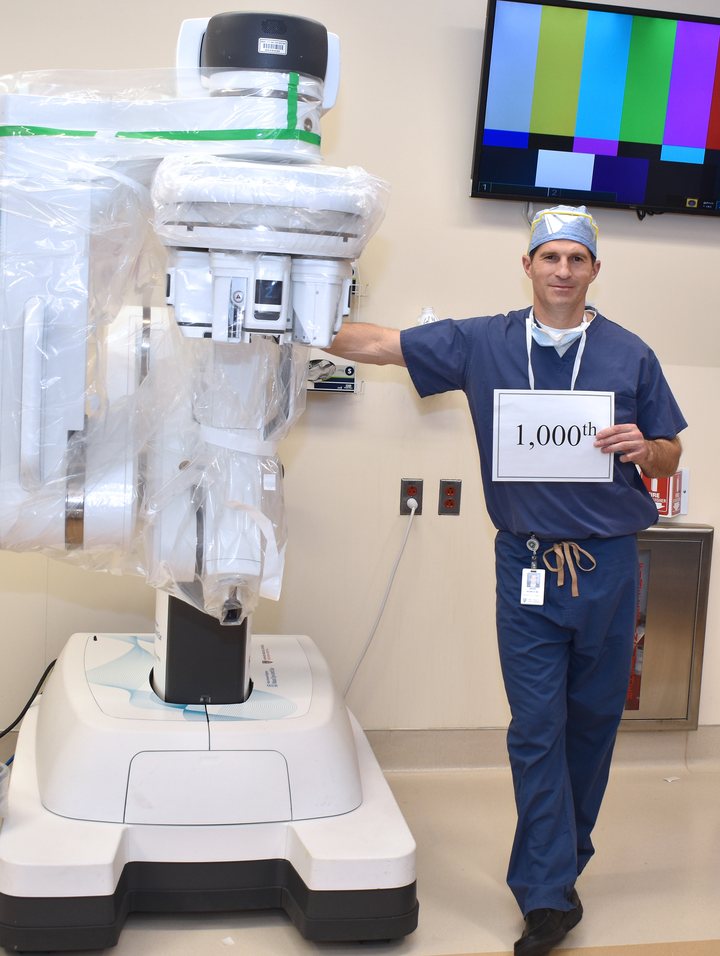
Dr. Richmon performed the first TORS at Johns Hopkins in 2009, the year the technique was cleared by the FDA, and built its head and neck robotic surgery program before bringing that experience to Mass Eye and Ear in 2016. He has trained residents and fellows in the technique and developed a residency curriculum for head and neck robotic surgery. He has completed more than 1,000 head and neck robotic surgeries and is one of the most experienced surgeons in the country.
Who TORS is for
- Early-stage tonsil and base of tongue cancer, especially HPV-related throat cancer. This is the most common use.
- Cancer of unknown primary, where a lymph node in the neck contains cancer but scans cannot find the source. Removing the tonsil and base of tongue tissue robotically finds the primary in most cases and can reduce the radiation field.
- Selected tumors of the larynx and lower throat that can be reached through the mouth.
- Selected recurrent tumors after prior radiation.
- Some benign tumors of the throat and tongue base.
- Some deep neck tumors located where removal through the throat is possible with the robot.
- Eagle syndrome, to remove an enlarged, painful styloid process.
Whether TORS is the right choice depends on the size and location of the tumor, whether it involves nearby structures, and the lymph nodes in the neck. Larger or more advanced tumors are usually better treated with radiation and chemotherapy, or with open surgery and reconstruction.
How the operation works
- Anesthesia and exposure Under general anesthesia, a retractor holds the mouth open and pushes the tongue out of the way.
- The robot is positioned A 3D camera and two thin instruments pass through the mouth. Dr. Richmon operates them from a console in the room, and an assistant stays at the patient's head.
- The tumor is removed The tumor comes out with a margin of normal tissue. The margins are checked by the pathologist during the operation.
- Neck dissection For most cancers, lymph nodes on the same side of the neck are removed through a neck incision, usually during the same anesthetic.
- Pathology The final report takes about a week. It shows the margins, the number of nodes involved, and whether cancer has spread outside a node. This report informs whether further treatment is needed.
Recovery
Most patients stay in the hospital one to three nights and go home swallowing liquids and soft foods. Throat pain is real for the first one to two weeks and is managed with medication. Most people are back to normal activity in two to three weeks. Because bleeding from the surgical site is the main risk during that time, patients (especially those traveling a distance) are asked to stay within reach of the hospital for 7 to 10 days after surgery.
How TORS compares with other treatments
| Approach | Incision | Typical hospital stay | What it offers |
|---|---|---|---|
| TORS | None on the face or neck; neck incision for lymph nodes | 1 to 3 nights | Removes the tumor and gives a pathology report that guides whether radiation is needed and at what dose. |
| Open surgery | Neck incision, sometimes splitting the jaw | 7 to 10 nights | Needed for large or deeply invasive tumors, usually with reconstruction. |
| Radiation with chemotherapy | None | Outpatient over 6 to 7 weeks | Standard for many advanced tumors and an alternative for early ones. Effects on swallowing, saliva, and taste can be long term and irreversible. |
Numbers are typical ranges. Your course depends on your tumor, your health, and the pathology.
Questions patients ask
Is TORS a robot doing the surgery?
No. Dr. Richmon controls every movement from a console a few feet from the patient. The robot holds a 3D camera and small instruments that pass through the mouth and lets him work with precision in a space that would otherwise require opening the neck or splitting the jaw.
Will I need radiation after TORS?
It depends on the pathology. If the tumor is removed with clear margins and few or no lymph nodes are involved, radiation may be avoided or given at a lower dose. If there are high-risk features, radiation, sometimes with chemotherapy, is recommended. The advantage of surgery first is that this decision is made on the actual pathology rather than on scans.
How long is the hospital stay?
Most patients stay one to three nights. The main goals before going home are comfortable swallowing of liquids and good pain control.
Will I be able to swallow normally afterward?
Most patients swallow liquids within a day or two and return to a normal diet over a few weeks. A feeding tube is rarely needed for early-stage tumors. A speech and swallowing therapist is part of the team.
What are the risks?
The most important risk is bleeding from the throat in the first two weeks, which is uncommon but can be serious, so patients stay near the hospital for the first 7 to 10 days. Others include temporary swallowing difficulty, changes in taste, and tooth or lip irritation from the retractor. Dr. Richmon will review the risks specific to your tumor.
Am I a candidate if I already had radiation?
Sometimes. TORS is used for selected recurrent tumors after radiation, and for tumors in a previously treated neck where open surgery would be difficult. This requires careful review of your scans and prior treatment.
Boston, MA 02114 Request an appointment through Mass General Brigham
Second opinions are welcome. Bring or send your pathology report and imaging so they can be reviewed before the visit.